 (+220) 385-7732

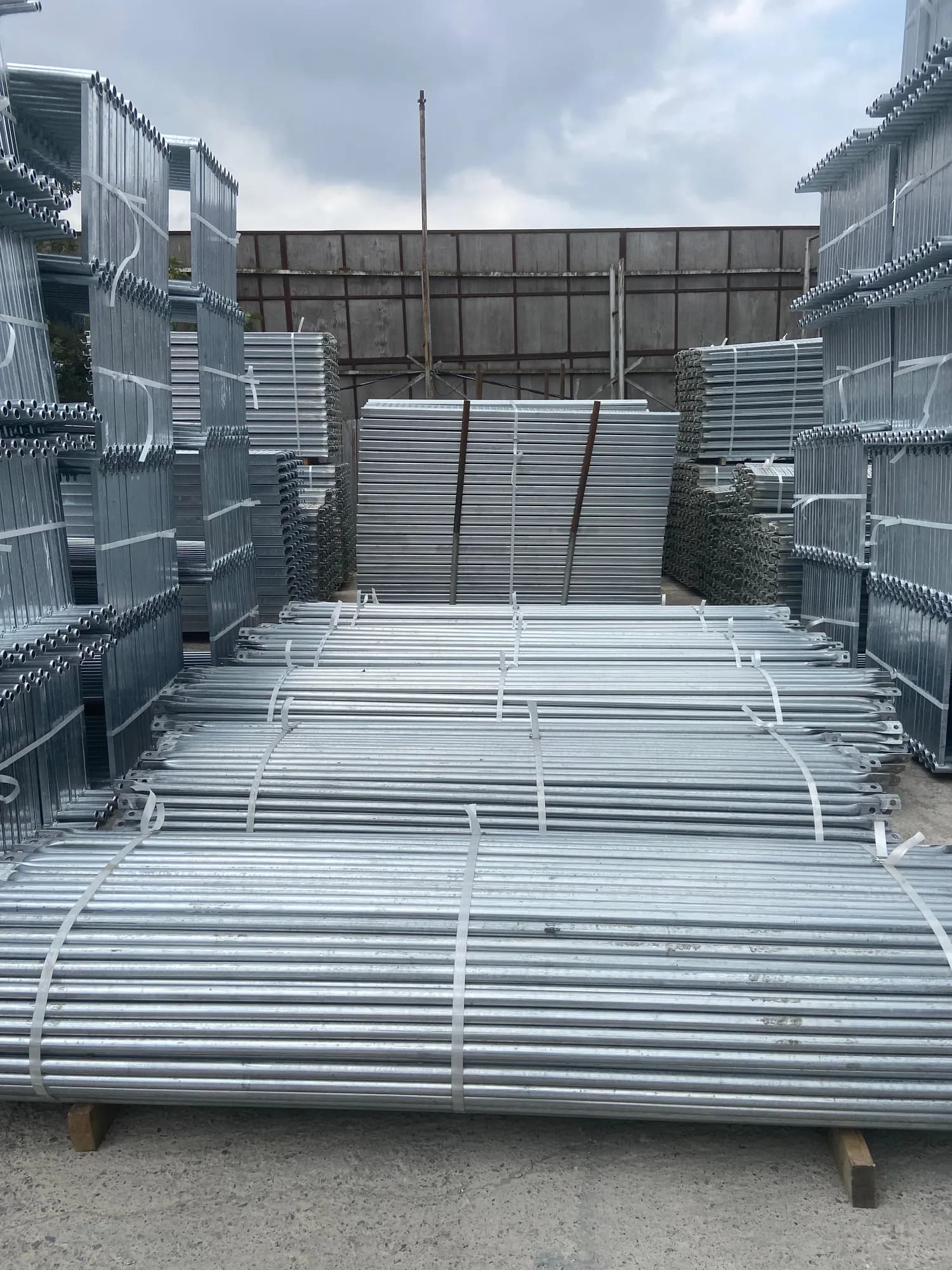
We rent two kinds of scaffolding: a steel frame system at D150 a day for multi-storey work, and mobile towers on lockable wheels at D200 a day for painting, plastering, electrical and ceiling work. The frame system has adjustable legs for uneven ground. The US safety regulator OSHA names concrete blocks as an unsafe thing to stand a scaffold on, and requires scaffold footings to be level, sound and rigid.
Price and which type to take come first, because both are quick. Then the slow part, and the one this post is really about: the ground under the legs.
What we rent
| Frame system | Mobile tower | |
|---|---|---|
| Price | D150 per day | D200 per day |
| Built from | Heavy-duty steel frames | Steel frame on lockable castor wheels |
| Legs | Adjustable, for uneven ground | Lockable wheels |
| Suits | Multi-storey construction | Painting, plastering, electrical, ceilings |
| Where to collect | Lamin Daranka · Jabang · Yarambamba ( OIC Road ) · Bijilo ( OIC Road ) · Jambanjelly | Same five branches |
The mobile tower also comes in a Safe Climb version with a ladder built into the frame, at the same D200. Full details are on the frame system and mobile tower pages.
Which one do you need?
Ask yourself one thing: does the work stay in one place, or does it move? The frame system is built for multi-storey construction, where the scaffold goes up once and stays. The mobile tower is meant for painting, plastering, electrical and ceiling work, indoors or out, where the job shifts from one spot to the next.
That is what the wheels are for. You roll the tower to the next patch, lock it, climb up, and carry on.
The block under the leg
If one leg of a scaffold ends up short of the ground, the quick fix is to push something under it. On a building site, a concrete block is an easy thing to reach for. Don't.
OSHA, the US body that writes the safety rules for building sites, has a name for things like that. Its rules are US law, not Gambian law, but they are published, specific and free to read, which is why we quote them. It calls such things "unstable objects", and its definition doesn't leave much room for argument.1
Unstable objects do not constitute a safe base support for scaffolds, platforms, or employees. Examples include, but are not limited to, barrels, boxes, loose brick, and concrete blocks.
Concrete blocks are named outright. The reason is in the first half of the definition, which describes items whose strength, shape or lack of stability may let them shift out of place, so they may not carry the load put on them.1
So what should be under the legs? OSHA's general scaffold rule says the poles, legs, frames and uprights must sit on base plates and mud sills (sole boards, to British-trained builders), or another adequate firm foundation.2 But the rule goes further than naming parts. It sets a standard for the footing itself.
Footings shall be level, sound, rigid, and capable of supporting the loaded scaffold without settling or displacement.
Notice the word "loaded". The test is the scaffold with people and materials on it, not the empty frame you put up in the morning.
And when the ground slopes? Put the two rules together: footings must be level, and blocks don't count as a support. Our frame system has adjustable legs for uneven ground, so a short leg can be extended rather than packed. For mobile towers, OSHA says it outright: where levelling is needed, screw jacks or equivalent means shall be used.3
Why is a rental company going on about ground? Because every rule above is about what sits under the steel, and that part is decided on your site.
How tall before it needs tying in
The rule compares how tall the scaffold is with how wide its base is, and OSHA draws the line at four to one: a supported scaffold taller than four times its base width must be held against tipping by guys, ties, bracing or something equivalent.2
That sounds abstract, so put numbers to it. If the base is 1.2 metres wide, four times that is 4.8 metres. Above 4.8 metres, the scaffold needs tying back to the building or bracing out. Below it, the four-to-one rule itself does not call for ties, though OSHA still wants them wherever the load sits off to one side, such as a platform sticking out past the frame.2
Once you are above that height, the ties repeat as you go up. OSHA lets them follow the scaffold manufacturer's recommendations. Otherwise, on a frame as wide as the 1.2 m example, the rows of ties go no more than 7.9 metres apart going up. Along the wall, there is a tie at each end and no more than 9.1 metres between ties.2
Climbing up, and the rails at the top
The cross braces on a frame scaffold form a big X, and an X looks a lot like a ladder. OSHA is short and blunt about it.
Crossbraces shall not be used as a means of access.
If the platform is more than 0.6 m (2 ft) above or below where you step on, the same rule lists what to use instead.2 Ladders, whether portable, hook-on or attached. Stair towers, ramps, and access built into the frame, among a few others. The Safe Climb version of our mobile tower has a ladder built into the frame.
Higher up, OSHA requires fall protection for anyone on a scaffold more than 3.1 m (10 ft) above a lower level.2 A guardrail is one accepted way to do it, and on a modern supported scaffold its top rail sits between 0.97 and 1.2 m (38 to 45 in) above the platform.2 Waist height, roughly.
Mobile towers: three rules
- Lock the wheels. OSHA requires castors and wheels to be locked while the scaffold is being used in one place.3
- Push low. Move it by pushing as close to the base as you can, and never more than 1.5 m (5 ft) above the ground.3
- Climb down before it moves. OSHA bans riding on a moving scaffold unless a list of conditions is met, including ground within 3 degrees of level and free of holes, and a tower no more than twice as tall as its base is wide, unless it is designed to a recognised stability test.3 The simplest way to meet that is to come down before it moves.
One more, with the rainy season in mind. OSHA prohibits work on scaffolds during storms or high winds unless a competent person has decided it is safe and the workers are protected by a personal fall arrest system or wind screens.2
Who checks the scaffold
We rent you the steel. We do not supervise the build, and we would be misleading you if we suggested otherwise. OSHA puts that job on a "competent person", someone able to spot the hazards on that site and with the authority to fix them on the spot.1 Under its rules, that person directs the erecting, moving and dismantling, and inspects the scaffold for visible defects before each work shift and after anything that could have weakened it.2
On your job, that has to be someone on your side, such as your builder or foreman. Make sure someone is actually doing it.
What to tell us when you order
- Frame system or mobile tower — or tell us the job and we will say which.
- How high you need to reach, and how long the wall or room is.
- What the ground is like — flat slab, packed earth, or a slope.
- How many days you need it.
WhatsApp (+220) 385-7732. If the work includes a slab, the props that hold it up are covered in the acro jack post. And if your ground slopes, say so when you message. Of everything in this post, it is the one thing that is easier to sort out before the scaffold reaches your site than after.
Common questions
- How much does it cost to hire scaffolding in The Gambia?
- At GLS Rental, the steel frame scaffolding system is D150 per day and the mobile tower on lockable wheels is D200 per day. The mobile tower with a built-in ladder, called Safe Climb, is also D200 per day. All are available from five branches: Lamin Daranka, Jabang, Yarambamba, Bijilo and Jambanjelly.
- Should I rent frame scaffolding or a mobile tower?
- GLS Rental's frame system is built for multi-storey construction. The mobile tower, on lockable wheels, is meant for painting, plastering, electrical and ceiling work, where the job moves from one spot to the next.
- Can I put a concrete block under a scaffold leg to level it?
- OSHA's definitions in 29 CFR 1926.450 list concrete blocks and loose brick as unstable objects, and state that unstable objects do not constitute a safe base support for scaffolds. OSHA 29 CFR 1926.451(c)(2)(i) also requires footings to be level, sound and rigid. GLS Rental's frame system has adjustable legs for uneven ground.
- How tall can a scaffold be before it needs tying to the building?
- OSHA 29 CFR 1926.451(c)(1) says a supported scaffold taller than four times its base width must be restrained from tipping by guys, ties, bracing or equivalent means. A scaffold with a 1.2 metre base reaches that point at 4.8 metres.
- Can you climb the cross braces on a scaffold?
- No. OSHA 29 CFR 1926.451(e)(1) states that crossbraces shall not be used as a means of access. Where a platform is more than 0.6 m (2 ft) above or below the point of access, OSHA requires ladders, stair towers, ramps or built-in access instead.
- Who is responsible for inspecting a rented scaffold?
- OSHA 29 CFR 1926.451(f)(3) requires a competent person to inspect scaffolds for visible defects before each work shift and after anything that could affect their structural integrity. OSHA is a US standard, quoted here because it is published and specific. GLS Rental rents the equipment and does not supervise the build.
Sources
Every technical figure above comes from one of these. We quote and summarise them; we do not add guidance of our own.
1. US Occupational Safety and Health Administration, Scaffolds: Scope, application and definitions applicable to this subpart (29 CFR 1926.450)
Cited for: The definitions of unstable objects (naming concrete blocks and loose brick) and of a competent person.
2. US Occupational Safety and Health Administration, General requirements (scaffolds) (29 CFR 1926.451)
Cited for: Base plates, mud sills and footings; the 4:1 height-to-base rule and tie spacing; the ban on climbing crossbraces and allowed means of access; fall protection above 10 feet and top-rail height; work in storms or high winds; supervision and inspection by a competent person.
3. US Occupational Safety and Health Administration, Additional requirements applicable to specific types of scaffolds (29 CFR 1926.452)
Cited for: Mobile scaffolds (paragraph w): locking casters, pushing near the base, conditions for riding, and levelling with screw jacks or equivalent means.
Tell us what you are building
Send your dates and a photo of the site or the drawing. We will work out what you need and what it costs.